
– Top players from the past
– World Champions
| Mikhail Botvinnik | |
|---|---|
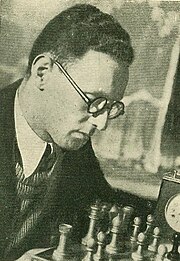 Mikhail Botvinnik |
|
| Full name | Mikhail Moiseyevich Botvinnik |
| Country |  Soviet Union Soviet Union |
| Born | August 17, 1911 Kuokkala, Grand Duchy of Finland, part of the Russian Empire (now Repino, Russia) |
| Died | May 5, 1995 (aged 83) Moscow, Russia |
| Title | Grandmaster |
| World Champion | 1948–1957 1958–1960 1961–1963 |
| Peak rating | 2660 (January 1971) [1] |
Mikhail Moiseyevich Botvinnik, Ph.D. (August 17 [ O.S. August 4] 1911 – May 5, 1995) was a Soviet and Russian International Grandmaster and three-time World Chess Champion. Working as an electrical engineer at the same time, he was one of the very few famous chess players who achieved distinction in another career while playing top-class competitive chess. He also developed a chess-playing algorithm that tried to « think » like a top human player, but this approach has been superseded by a brute-force search strategy that exploits the rapid increase in the calculation speed of modern computers.
Botvinnik was the first world-class player to develop within the Soviet Union ( Alekhine was a top player before the Russian Revolution), putting him under political pressure but also giving him considerable influence within Soviet chess. From time to time he was accused of using that influence to his own advantage, but the evidence is unclear and some suggest he resisted attempts by Soviet officials to intimidate some of his rivals.
Botvinnik also played a major role in the organization of chess, making a significant contribution to the design of the World Chess Championship system after World War II and becoming a leading member of the coaching system that enabled the Soviet Union to dominate top-class chess during that time. His famous pupils include World Champions Anatoly Karpov, Garry Kasparov and Vladimir Kramnik.
Playing top class chess for decades, being an eminent chess author, one of the pioneers of computer chess, and a great chess teacher in his late years, Botvinnik is widely regarded as the most influental chess contributor in the 20th century.
Contents |
Early years
Mikhail Moiseyevich Botvinnik was born on August 17, 1911, in what was then Kuokkala in the Russian-controlled but autonomous Grand Duchy of Finland, but is now the district of Repino in Saint Petersburg. Although his parents were Jewish, his father was a dental technician and his mother a dentist, which allowed the family to live outside the Pale of Settlement to which most Jews in Russia were restricted at the time. As a result, Mikhail Botvinnik grew up in Saint Petersburg’s Nevsky Prospekt. His father forbade the speaking of Yiddish at home, and Mikhail and his older brother Issy attended Soviet schools. Mikhail Botvinnik later said, « I am a Jew by blood, Russian by culture, Soviet by upbringing. »
In 1920, his mother became ill and his father left the family, but maintained contact with the children, even after his second marriage, to a Russian woman. At about the same time, Mikhail started reading newspapers, and became a committed Communist.
In autumn 1923, at the age of twelve, Mikhail Botvinnik was taught chess by a school friend of his older brother, using a home-made set, and instantly fell in love with the game. He finished in mid-table in the school championship, sought advice from another of his brother’s friends, and concluded that for him it was better to think out « concrete concepts » and then derive general principles from these – and went on to beat his brother’s friend quite easily. In winter 1924, Botvinnik won his school’s championship, and exaggerated his age by three years in order to become a member of the Petrograd Chess Assembly – to which the Assembly’s President turned a blind eye. Botvinnik won his first two tournaments organized by the Assembly. Shortly afterwards, Nikolai Krylenko, a chess fanatic and leading member of the Soviet legal system who later organized Joseph Stalin’s show trials, began building a huge nation-wide chess organization, and the Assembly was replaced by a club in the city’s Palace of Labor.
To test the strength of Soviet chess masters, Krylenko organized the Moscow 1925 chess tournament. On a rest day during the event, world champion José Raúl Capablanca gave a simultaneous exhibition in Leningrad. Botvinnik was selected as one of his opponents, and won their game. In 1926, he reached the final stage of the Leningrad championship. Later that year, he was selected for Leningrad’s team in a match against Stockholm, held in Sweden, and scored +1 =1 against the future grandmaster Gösta Stoltz. On his return, he entertained his schoolmates with a vivid account of the rough sea journey back to Russia. Botvinnik was commissioned to annotate two games from the match, and the fact that his analyses were to be published made him aware of the need for objectivity. In December 1926, he became a candidate member of his school’s Komsomol branch. Around this time his mother became concerned about his poor physique, and as a result he started a program of daily exercise, which he maintained for most of his life.


Botvinnik in 1927
When Botvinnik finished the school curriculum, he was below the minimum age for the entrance examinations for higher education. While waiting, he qualified for his first USSR Championship final stage in 1927 as the youngest player ever at that time, tied for fifth place and won the title of National Master. He wanted to study Electrical Technology at the Leningrad Polytechnical Institute and passed the entrance examination; however, there was a persistent excess of applications for this course and the Prolestud, which controlled admissions, had a policy of admitting only children of engineers and industrial workers. After an appeal by a local chess official, he was admitted in 1928 to Leningrad University’s Mathematics Department. In January 1929, Botvinnik played for Leningrad in the student team chess championship against Moscow. Leningrad won and the team manager, who was also Deputy Chairman of the Prolestud, secured Botvinnik a transfer to the Polytechnic’s Electromechanical Department, where he was one of only four students who entered straight from school. As a result, he had to do a whole year’s work in five months, and failed one of the examinations. Early in the same year he placed joint third in the semi-final stage of the USSR Championship, and thus failed to reach the final stage.
His early progress was fairly rapid, mostly under the training of Soviet Master and coach Abram Model, in Leningrad; Model taught Botvinnik the Winawer Variation of the French Defence, then regarded as inferior for Black, but which Model and Botvinnik analyzed more deeply, and then played with great success.
He won the Leningrad Masters’ tournament in 1930 with 6½/8, following this up the next year by winning the Championship of Leningrad by 2½ points over former Soviet champion Peter Romanovsky.
His wife was an Armenian Russian named Gayane (Ganna) Davidovna, the daughter of his algebra and geometry teacher. She was a student at the Vaganova Academy of Russian Ballet in Leningrad and later, a ballerina in the Bolshoi Theatre. They had one daughter named Olga, born in 1941.
Soviet champion
 |
a | b | c | d | e | f | g | h | |
| 8 |  |
 |
 |
|
 |
 |
|
|
8 |
| 7 | |
 |
|
 |
 |
|
 |
|
7 |
| 6 | |
 |
|
|
|
|
 |
 |
6 |
| 5 | |
|
|
|
|
|
|
|
5 |
| 4 | |
|
|
 |
 |
|
|
|
4 |
| 3 | |
 |
|
|
 |
|
|
|
3 |
| 2 | |
|
 |
|
 |
|
|
|
2 |
| 1 | |
|
 |
 |
|
|
 |
|
1 |
|
a | b | c | d | e | f | g | h | |
Soviet Championship in Moscow, scoring 13½ out of 17. He commented that the field was not very strong, as some of the pre- Revolution masters were absent. In late summer 1931, he graduated with a degree in Electrical Engineering, after completing a practical assignment on temporary transmission lines at the Dnieper Hydroelectric Station. He stayed on at the Leningrad Polytechnical Institute to study for a Candidate’s degree.
In 1933, he repeated his Soviet Championship win, in his home city of Leningrad, with 14/19, describing the results as evidence that Krylenko’s plan to develop a new generation of Soviet masters had borne fruit. He and other young masters successfully requested the support of a senior Leningrad Communist Party official in arranging contests involving both Soviet and foreign players, as there had been none since the Moscow 1925 chess tournament. Soon afterwards, Botvinnik was informed that Alexander Ilyin-Genevsky, one of the older masters and a member of the Soviet embassy in Prague, had arranged a match between Salo Flohr and himself, with his opponent then regarded as one of the most credible contenders for Alexander Alekhine’s World Chess Championship title. The highest-level chess officials in the Soviet Union opposed this on the grounds that Botvinnik stood little chance against such a strong opponent, which caused Krylenko to insist on the match, saying that « We have to know our real strength. »
Botvinnik used what he regarded as the first version of his method of preparing for a contest, but fell two games behind by the end of the first six, played in Moscow. However, aided by his old friend Ragozin and coach Abram Model, he leveled the score in Leningrad and the match was drawn. When describing the post-match party, Botvinnik wrote that at the time he danced the foxtrot and Charleston to a professional standard.
In his first tournament outside the USSR, the Hastings 1934–35, Botvinnik achieved only a tie for 5th-6th places, with 5/9. He wrote that, in London after the tournament, Emanuel Lasker said his arrival only two hours before the first round began was a serious mistake and that he should have allowed ten days for acclimatization. Botvinnik wrote that he did not make this mistake again.
Botvinnik placed first equal with Flohr, ½ point ahead of Lasker and one point ahead of José Raúl Capablanca, in Moscow’s second International Tournament, held in 1935. After consulting Capablanca and Lasker, Krylenko proposed to award Botvinnik the title grandmaster, but Botvinnik objected that « titles were not the point. » However, he accepted a free car and a 67% increase in his postgraduate study grant, both provided by the People’s Commissariat of Heavy Industry.

Botvinnik vs Lasker in 1936
He later reported to Krylenko that the 1935 tournament made it difficult to judge the strength of the top Soviet players, as it included a mixture of top-class and weaker players. Botvinnik advocated a double round-robin event featuring the top five Soviet players and the five strongest non-Soviet players available. Despite politicking over the Soviet choices, both Krylenko and the Central Committee of the Komsomol quickly authorised the tournament. This was played in Moscow in June 1936, and Botvinnik finished second, one point behind Capablanca and 2½ ahead of Flohr. However, he took consolation from the fact the Soviet Union’s best had held their own against top-class competition.
In early winter, 1936, Botvinnik was invited to play in a tournament at Nottingham, England. Krylenko authorized his participation and, to help Botvinnik play at his best, allowed Botvinnik’s wife to accompany him – a privilege rarely extended to chess players at any time in Soviet history. Taking Lasker’s advice, Botvinnik arrived ten days before play started. Although his Soviet rivals forecast disaster for him, he scored an undefeated shared first place (+6 =8) with Capablanca, ½ point ahead of current World Champion Max Euwe and rising American stars Reuben Fine and Samuel Reshevsky, and 1 point ahead of ex-champion Alexander Alekhine. This was the first tournament victory by a Soviet master outside his own country. When the result reached Russia, Krylenko drafted a letter to be sent in Botvinnik’s name to Stalin. On returning to Russia Botvinnik discovered he had been awarded the « Mark of Honour ».
Three weeks later, he began work on his dissertation for the Candidate’s degree, obtaining this in June 1937, after his supervisor described the dissertation as « short and good », and the first work in its field. As a result of his efforts, he missed the 1937 Soviet championship, won by Grigory Levenfish, who was then nearly fifty. Later in 1937, Botvinnik drew a match of thirteen games against Grigory Levenfish. Accounts differ about how the match was arranged: Levenfish later wrote that Botvinnik challenged him; while Botvinnik wrote that Krylenko, angered by Botvinnik’s absence from the tournament, ordered the match.
Botvinnik won further Soviet Championship titles in 1939, 1944, 1945, and 1952, bringing his total to six – a record he shares with Mikhail Tal. In 1945 he dominated the tournament, scoring 15/17; however in 1952 he tied with Mark Taimanov and won the play-off match.
World title contender

Capablanca vs Botvinnik in 1936
In 1938, the world’s top eight players met in the Netherlands to compete in the AVRO tournament, whose winner was supposed to get a title match with the World Champion, Alexander Alekhine. Botvinnik placed third, behind Paul Keres and Reuben Fine. According to Botvinnik, Alekhine was most interested in playing an opponent who could raise the funds. After consulting the nearest available Soviet officials, Botvinnik discreetly challenged Alekhine, who promptly accepted, subject to conditions that would enable him to acclimatize in Russia and get some high-quality competitive practice a few months before the match. In Botvinnik’s opinion, Alekhine was partly motivated by the desire for a reconciliation with the Soviet authorities, so that he could again visit his homeland. The match, including funding, was authorised at the highest Soviet political level in January 1939; however, a letter of confirmation was only sent two months later – in Botvinnik’s opinion, because of opposition by his Soviet rivals, especially those who had become prominent before the Russian Revolution – and the outbreak of World War II prevented a World Championship match.
In spring 1939, Botvinnik won the USSR Championship, and his book on the tournament described the approach to preparation which he had been developing since 1933. One striking feature of this was emphasis on opening preparation in order to gain a permanent positional advantage in the middle game, rather than seeking immediate tactical surprises that could only be used once.
Botvinnik took an early lead in the 1940 USSR Championship, but faded badly in the later stages, eventually sharing fifth place. He attributed this to the unaccustomed difficulty of concentrating in a party-like atmosphere filled with noise and tobacco smoke. Botvinnik wrote to a friendly official, commenting that the champion was to be the winner of a match between Igor Bondarevsky and Andor Lilienthal, who had tied for first place, but had no achievements in international competition. The official’s efforts led to a tournament for the title of « Absolute Champion of the USSR », whose official aim was to identify a Soviet challenger for Alekhine’s title. The contestants were the top six finishers in the Soviet Championship – Bondarevsky, Lilienthal, Paul Keres (who had recently become a Soviet citizen), future World Champion Vasily Smyslov, Isaac Boleslavsky and Botvinnik – who were to play a quadruple round robin. Botvinnik’s preparation with his second, Viacheslav Ragozin, included training matches in noisy, smoky rooms and he slept in the playing room, without opening the window. He won the tournament, 2½ points ahead of Keres and three ahead of Smyslov; moreover, with plus scores in the « mini-matches » against all his rivals.
In June 1941 Nazi Germany invaded the Soviet Union. Botvinnik’s wife Gayane, a ballerina, told him that her colleagues at the Kirov Opera and Ballet Theatre were being evacuated to the city of Perm, then known as Molotov in honour of Vyacheslav Molotov. The family found an apartment there, and Botvinnik obtained a job with the local electricity supply organization – at the lowest pay rate and on condition that he did no research, as he had only a Candidate’s degree. Botvinnik’s only child, a daughter named Olya, was born in Perm in April 1942.
In the evenings, Botvinnik wrote a book in which he annotated all the games of the « Absolute Championship of the USSR », in order to maintain his analytic skills in readiness for a match with Alekhine. His work included wood-cutting for fuel, which left him with insufficient energy for chess analysis. Botvinnik obtained from Molotov an order that he should be given three days off normal work in order to study chess.
In 1943, after a two-year lay-off from competitive chess, Botvinnik won a tournament in Sverdlovsk, scoring 1½ out of 2 against each of his competitors – who included Smyslov, Vladimir Makogonov, Boleslavsky, and Ragozin. Chessbase regards this as one of the fifty strongest tournaments between 1851 and 1986.
Shortly afterwards, Botvinnik was urged to return to Moscow by the People’s Commissar for Power Stations, an admirer and subsequent good friend. On his return, Botvinnik suggested a match with Samuel Reshevsky in order to strengthen his claim for a title match with Alekhine, but this received no political support. In December 1943, he won the Moscow Championship, ahead of Smyslov. At the same time, opposition to his plan for a match with Alekhine re-surfaced, on the grounds that Alekhine was a political enemy and the only proper course was to demand that he be stripped of the title. The dispute ended in Botvinnik’s favor, and in the dismissal of a senior chess official, one of those to have opposed Botvinnik’s plan, who was also a KGB colonel.
After Botvinnik won the 1944 and 1945 Soviet championships, most top Soviet players supported his desire for a World Championship match with Alekhine. However, the allegations that Alekhine had written anti-Semitic articles while in Nazi-occupied France made it difficult to host the match in the USSR. Botvinnik opened negotiations with the British Chess Federation to host the match in England, but these were cut short by Alekhine’s death in 1946.
When the Second World War ended, Botvinnik won the first high-level post-war tournament, at Groningen in 1946, with 14½ points from nineteen games, ½ point ahead of former World Champion Max Euwe and two ahead of Smyslov. He and Euwe both struggled in the last few rounds, and Botvinnik had a narrow escape against Euwe, who he acknowledged had always been a difficult opponent for him. This was Botvinnik’s first outright victory in a tournament outside the Soviet Union.
Botvinnik also won the very strong Mikhail Chigorin Memorial tournament held at Moscow 1947.
World Champion
Botvinnik strongly influenced the design of the system which would be used for World Championship competition from 1948 to 1963. Viktor Baturinsky wrote « Now came Botvinnik’s turn to defend his title in accordance with the new qualifying system which he himself had outlined in 1946 » (this statement referred to Botvinnik’s 1951 title defence).
On the basis of his strong results during and just after World War II, Botvinnik was one of five players to contest the 1948 World Chess Championship, which was held at The Hague and Moscow. He won the 1948 tournament convincingly, with a score of 14/20, three points clear, becoming the sixth World Champion. While he was on vacation in Riga after the tournament, an eleven-year old boy called Mikhail Tal paid a visit, hoping to play a game against the new champion. Tal was met by Botvinnik’s wife, who said the champion was asleep, and that she had made him take a rest from chess.
Botvinnik then held the title, with two brief interruptions, for the next fifteen years, during which he played seven world championship matches. In 1951, he drew with David Bronstein over 24 games in Moscow, +5 =14 -5, keeping the world title, but it was a struggle for Botvinnik, who won the second-last game and drew the last in order to tie the match. In 1954, he drew with Vasily Smyslov over 24 games at Moscow, +7 =10 -7, again retaining the title. In 1957, he lost to Smyslov by 9½–12½ in Moscow, but the rules then in force allowed him a rematch without having to go through the Candidates’ Tournament, and in 1958 he won the rematch in Moscow; Smyslov said his health was poor during the return match. In 1960, Botvinnik was convincingly beaten 8½-12½ at Moscow by Tal, now 23 years old, but again exercised his right to a rematch in 1961, and won by 13–8 in Moscow. Commentators agreed that Tal’s play was weaker in the rematch, probably due to his health, but also that Botvinnik’s play was better than in the 1960 match, largely due to thorough preparation. Botvinnik changed his style in the rematch, avoiding the tactical complications in which Tal excelled and aiming for closed positions and endgames, where Tal’s technique was not outstanding. Finally, in 1963, he lost the title to Tigran Petrosian, by 9½-12½ in Moscow. FIDE had by then altered the rules, and he was not allowed a rematch. The rematch rule had been nicknamed the « Botvinnik rule », because he twice benefited from it.
Though ranking as formal World Champion, Botvinnik had a relatively poor playing record in the early 1950s: he played no formal competitive games after winning the 1948 match tournament until he defended his title, then struggled to draw his 1951 championship match with Bronstein, placed only fifth in the 1951 Soviet Championship, and tied for third in the 1952 Géza Maróczy Memorial tournament in Budapest; and he had also performed poorly in Soviet training contests. Botvinnik did not play in the Soviet team that won the 1952 Chess Olympiad in Helsinki: the players voted for the line-up and placed Botvinnik on second board, with Keres on top board; Botvinnik protested and refused to play. Keres’ playing record from 1950 to early 1952 had been outstanding.
Botvinnik won the 1952 Soviet Championship (joint first with Mark Taimanov in the tournament, won the play-off match). He included several wins from that tournament over the 1952 Soviet team members in his book Botvinnik’s Best Games 1947–1970, writing « these games had a definite significance for me ». In 1956, he tied for first place with Smyslov in the 1956 Alexander Alekhine Memorial in Moscow, despite a last-round loss to Keres.
Team tournaments
Botvinnik was selected for the Soviet Olympiad team from 1954 to 1964 inclusively, and helped his team to gold medal finishes each of those six times. At Amsterdam 1954 he was on board one and won the gold medal with 8?/11. Then at home for Moscow 1956, he was again board one, and scored 9?/13 for the bronze medal. For Munich 1958, he scored 9/12 for the silver medal on board one. At Leipzig 1960, he played board two behind Mikhail Tal, having lost his title to Tal earlier that year; But he won the board two gold medal with 10?/13. He was back on board one for Varna 1962, scored 8/12, but failed to win a medal for the only time at an Olympiad. His final Olympiad was Tel Aviv 1964, where he won the bronze with 9/12, playing board 2 as he had lost his title to Petrosian. Overall, in six Olympiads, he scored 54½/73 for an outstanding 74.6 percent.
Botvinnik also played twice for the USSR in the European Team Championship. At Oberhausen 1961, he scored 6/9 for the gold medal on board one. But at Hamburg 1965, he struggled on board two with only 3½/8. Both times the Soviet Union won the team gold medals. Botvinnik played one of the final events of his career at the Russia (USSR) vs Rest of the World match in Belgrade 1970, scoring 2½/4 against Milan Matulovic, as the USSR narrowly triumphed.
Late career
After losing the world title for the final time, to Tigran Petrosian in Moscow in 1963, Botvinnik withdrew from the following World Championship cycle after FIDE declined, at its annual congress in 1965, to grant a losing champion the automatic right to a rematch. He remained involved with competitive chess, appearing in several highly-rated tournaments and continuing to produce memorable games.
He retired from competitive play in 1970, aged 59, preferring instead to occupy himself with the development of computer chess programs and to assist with the training of younger Soviet players, earning him the nickname of « Patriarch of the Soviet Chess School » (see below).
Botvinnik’s autobiography, K Dostizheniyu Tseli, was published in Russian in 1978, and in English translation as Achieving the Aim ( ISBN 0-08-024120-4) in 1981. A staunch Communist, he was noticeably shaken by the collapse of the Soviet Union and lost some of his standing in Russian chess during the Boris Yeltsin era.
In the 1980s Botvinnik proposed a computer program to manage the Soviet economy, however his proposals did not receive significant attention from the Soviet government.
During the last few years of his life he personally financed his economic computer project that he hoped would be used to manage the Russian economy. He kept actively working on the program until his death and financing the work from the money he made for the lectures and seminars he attended, despite prominent health problems.
Botvinnik died of pancreatic cancer in 1995.
The Soviet Union regarded chess as a symbol of Communist superiority, and hence the Soviet chess world was extremely politicized. As Botvinnik was the first world-class player produced by the Soviet Union, everything he said or did (or did not say or do) had political repercussions, and there were rumors that Soviet opponents were given hints that they should not beat him.
David Bronstein wrote that Boris Verlinsky had won the 1929 Soviet Championship and was granted the first Soviet Grandmaster title for this achievement, yet he was later stripped of it, when it was thought more politically correct to make Botvinnik the first official Soviet GM (as distinct from the-then nonexistent FIDE grandmaster title).
Botvinnik wrote that before the last round of the 1935 Moscow tournament Soviet Commissar of Justice Nikolai Krylenko, who was also in charge of Soviet chess, proposed that Ilya Rabinovich should deliberately lose to Botvinnik, to ensure that Botvinnik took first place. Botvinnik refused, saying « … then I will myself put a piece en prise and resign ». The game was drawn, and Botvinnik shared first place with Salo Flohr.
Botvinnik sent an effusive telegram of thanks to Joseph Stalin after his victory at the great tournament in Nottingham in 1936. Many years later he said that it had been written in Moscow and that KGB agents told him to sign it.
Botvinnik played relatively poorly in the very strong 1940 Soviet Championship, finishing in a tie for fifth/sixth places, with 11½/19, two full points behind Igor Bondarevsky and Andor Lilienthal. With World War II under way by this time, and the strong possibility of little or no chess for some time in the future, Botvinnik seems to have prevailed upon the Soviet chess leadership to hold another tournament « in order to clarify the situation ». This wound up being the 1941 Absolute Championship of the USSR, which featured the top six finishers from the 1940 event, playing each other four times. After a personal appeal to the defence minister, Vyacheslav Molotov, Botvinnik was exempted from war work for three days a week in order to concentrate on chess preparations. [57] He won this tournament convincingly, and thus reclaimed his position as the USSR’s top player. Bronstein claimed that at the end of the 1946 Groningen tournament, a few months after the death of reigning world champion Alexander Alekhine, Botvinnik personally invited Samuel Reshevsky, Reuben Fine, Max Euwe, Vasily Smyslov, and Paul Keres to join him in a tournament to decide the new world champion, [38] but other evidence suggests that FIDE (the « governing body » of chess), had already proposed a World Championship tournament before the Groningen tournament began, and at this stage the Soviet Union was not a member and therefore took no part in framing that proposal.
Since Keres lost his first four games against Botvinnik in the 1948 World Championship tournament, winning only in the final cycle after the outcome of the tournament had been decided, suspicions have sometimes been raised that Keres was forced to « throw » games to allow Botvinnik to win the Championship. Chess historian Taylor Kingston investigated all the available evidence and arguments, and concluded that: Soviet chess officials gave Keres strong hints that he should not hinder Botvinnik’s attempt to win the World Championship; Botvinnik only discovered this about half-way through the tournament and protested so strongly that he angered Soviet officials; Keres probably did not deliberately lose games to Botvinnik or anyone else in the tournament.
Bronstein insinuated that Soviet officials pressured him to lose in the 1951 world championship match so that Botvinnik would keep the title, but comments by Botvinnik’s second, Salo Flohr, and Botvinnik’s own annotations to the critical 23rd game indicate that Botvinnik knew of no such plot.
In 1956, FIDE changed the world championship rules so that a defeated champion would have the right to a return match. Yuri Averbakh alleged that this was done at the urging of the two Soviet representatives in FIDE, who were personal friends of Botvinnik. Averbakh also claims that Botvinnik’s friends were behind FIDE’s decision in 1956 to limit the number of players from the same country that could compete in the Candidates Tournament, and that this was to Botvinnik’s advantage as it reduced the number of Soviet players he might have to meet in the title match.
Botvinnik asked to be allowed to play in the 1956 Candidates Tournament, as he wanted to use the event as part of his warm-up for the next year’s title match, but his request was refused.
Mikhail Tal’s chronic kidney problems contributed to his defeat in his 1961 return match with Botvinnik, and his doctors in Riga advised that he should postpone the match for health reasons. Averbakh claimed that Botvinnik would agree to a postponement only if Tal was certified unfit by Moscow doctors, and that Tal then decided to play.
While there is no doubt that Botvinnik sincerely believed in Communism, he by no means submissively followed the party line. In 1954, he wrote an article about inciting socialist revolution in western countries, aiming to spread Communism without a third world war. And in 1960 Botvinnik wrote a letter to the Soviet Government proposing economic reforms that were contrary to party policy.
In 1976 Soviet grandmasters were asked to sign a letter condemning Viktor Korchnoi as a « traitor » after Korchnoi defected. Botvinnik evaded this « request » by saying that he wanted to write his own letter denouncing Korchnoi. By this time, however, his importance had waned and officials would not give him this « privilege », so Botvinnik’s name did not appear on the group letter – an outcome Botvinnik may have foreseen. Bronstein and Boris Spassky openly refused to sign the letter.
Assessment
Playing strength and style
- For more information see Comparing top chess players throughout history
Reuben Fine observed that Botvinnik was at or near the top of the chess world for thirty years – from 1933, when he drew a match against Flohr, to 1963, when he lost the world championship for the final time, to Petrosian – « a feat equaled historically only by Emanuel Lasker and Steinitz ». The statistical rating system used in Raymond Keene and Nathan Divinsky’s book Warriors of the Mind concludes that Botvinnik was the fourth strongest player of all time: behind Garry Kasparov, Anatoly Karpov and Bobby Fischer but ahead of José Raúl Capablanca, Lasker, Viktor Korchnoi, Boris Spassky, Vasily Smyslov and Tigran Petrosian. The Chessmetrics system is sensitive to the length of the periods being compared, but places Botvinnik third in a comparison of players’ best individual years (1946 for Botvinnik) and sixth in a comparison of fifteen-year periods (1935–1949 in Botvinnik’s case). In 2005 Chessmetrics’ creator Jeff Sonas wrote an article which examined various ways of comparing the strength of « world number one » players, some not based on Chessmetrics; and Botvinnik generally emerged as one of the top six (the greatest exceptions were in criteria related to tournament results). [68] FIDE did not adopt the Elo rating system until 1970, by which time Botvinnik’s strength had been declining for several years. According to unofficial calculations by Arpad Elo, Botvinnik was the highest-rated player from 1937 to 1954, peaking about 2730 in 1946.
This may seem surprising in the light of Botvinnik’s results in the 1950s and early 1960s, when he failed to win a world championship match outright (as reigning champion) and his tournament results were patchy. But after the FIDE world championship cycle was established in 1948, reigning champions had to play the strongest contender every three years, and successful title defenses became less common than in the pre-World War II years, when the titleholder could select his challenger. Despite this, Botvinnik held the world title for a longer period than any of his successors except Garry Kasparov. Botvinnik also became world champion at the relatively late age of 37, because World War II brought international competition to a virtual halt for six years; and he was 52 years old when he finally lost his title (only Wilhelm Steinitz and Emanuel Lasker were older when they were defeated). Botvinnik’s best years were from 1935 to 1946; [67] during that period he dominated Soviet chess; [70] and the USSR’s 15½-4½ win in the 1945 radio match against the USA proved that the USSR’s top players were considerably better than the USA’s (who had dominated international team competitions in the 1930s).
|
a | b | c | d | e | f | g | h | |
| 8 | |
|
|
|
|
|
|
|
8 |
| 7 | |
|
|
|
|
|
|
|
7 |
| 6 | |
|
|
|
|
|
|
|
6 |
| 5 | |
 |
|
|
|
|
|
|
5 |
| 4 | |
|
|
|
|
|
|
|
4 |
| 3 | |
|
|
|
|
|
|
|
3 |
| 2 | |
 |
|
|
|
|
|
|
2 |
| 1 | |
|
 |
|
|
|
|
 |
1 |
|
a | b | c | d | e | f | g | h | |